

Wealth, weather and winterwear. Understanding regional gaps in children’s outer clothing
Ask any parent and they’ll agree: keeping kids equipped for the outdoors is quite the challenge. Between the mud, the tumbles, and the growth spurts, jackets and trousers face plenty of wear and tear, so much so it often feels impossible for them to last a whole season. For many families, being ready with the right outerwear each winter can feel like an uphill battle and an unavoidable expense, especially in regions where it rains for half the year and good gear is essential.
At TOG24, we wanted to understand just how much this issue affects families across the country - so we dug into the numbers. The result is our latest piece of research, the TOG24 UK kids’ winterwear index for 2025, showing that some parts of the country face much tougher, more expensive winters than others.
WHAT THE DATA REVEALS ABOUT UK FAMILIES
The TOG24 UK Kids’ Winterwear Index 2025 combines ONS family spending data with Met Office weather records to measure how climate conditions influence the cost of keeping our nation's kids warm and dry.
We looked at each region through three key lenses:
-
How much families actually spend on kids’ outerwear each week (ONS data).
-
The weather - from average temperatures to total rainfall and number of rainy days.
-
Disposable income - how much households typically have to spend.
These were combined into our Kids’ winterwear index - a score showing how costly and challenging it is to keep children warm and dry in each region. A higher score means that families in that area face harsher weather and usually spend a bigger portion of their household budget on children’s outerwear to keep them warm and dry.
ONS family spending data shows that across the UK, families are spending an average of 80p - £1 per week on children’s outerwear - but that figure changes significantly depending on the local temperature, rainfall, and how many wet days a region sees.
The table summarises regional scores across spend and winter severity, providing a clearer view of the relative demand for children’s outer layers across the country.
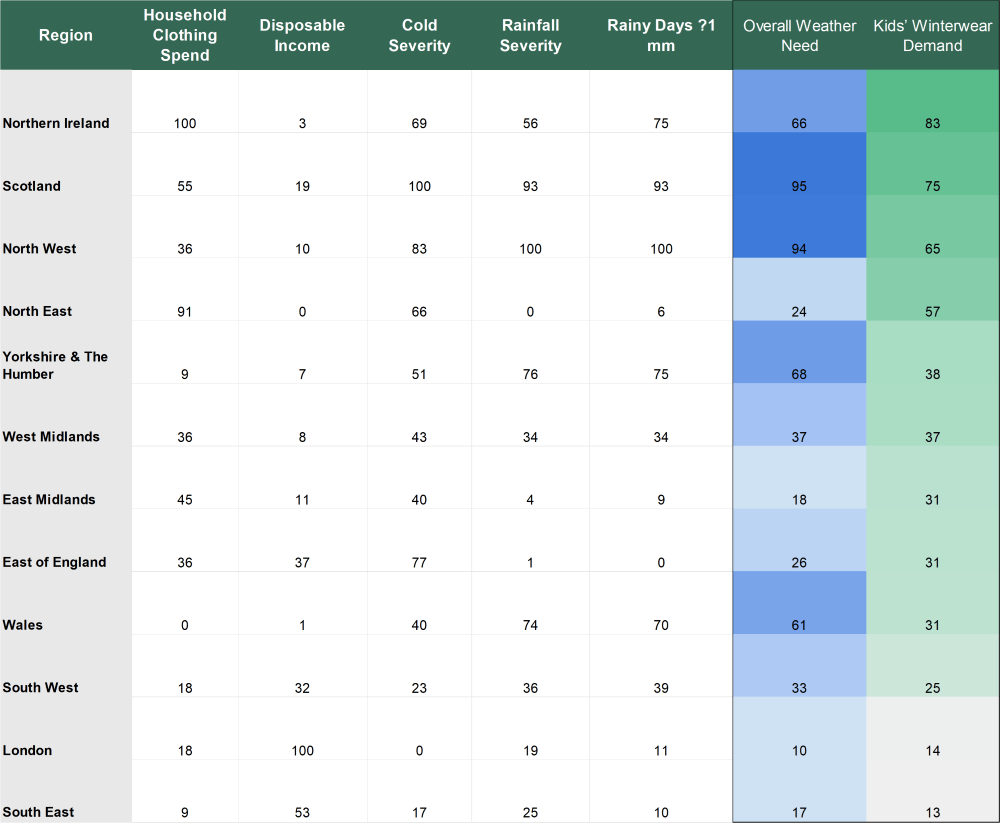
REGION BY REGION, THE COST OF KEEPING KIDS WARM.
The numbers paint a clear picture: families living in colder, wetter parts of the UK are paying more to keep their kids warm and dry - even though they typically have less to spend.
-
Northern Ireland tops the list with the highest household spend on children’s outerwear and the lowest disposable income.
-
Scotland and the North West follow closely behind - both see some of the colder temperatures on average, heaviest rainfall and highest spending.
-
Meanwhile, families in the South East and London spend the least, with far milder temperatures and fewer rainy days reducing the year-round need for outerwear.
We are witnessing, once again, a north-south divide in more ways than one. Put simply, bad weather comes with a bigger price tag.
A WORD FROM OUR EXPERTS: HOW TO MAKE CHILDREN’S COATS LAST
With costs rising across the board, parents are having to make every penny stretch - and unfortunately, kids don’t stop growing just because times are tight. Coats wear out, sleeves shorten, and budgets buckle.
When outerwear doesn’t fit properly or loses its waterproofing, kids feel it first. They get cold quicker, spend less time outdoors and are more likely to come home with sniffles or colds - which means they end up missing school.
Parents feel it too, facing the pressure of replacing costly kit mid-season, taking time off work to care for poorly little ones, and constantly weighing up cost against quality. This is where the real challenge comes in: making every piece of winter gear last longer.
TOG24’s own Simon Ward, part of the brand’s founding family, and his team of design and product experts have put their heads together to provide essential tips to help parents choose and maintain their children’s winterwear.

What should parents look out for when choosing a winter coat for their children?
When choosing a child’s winter coat, it helps to understand how different materials ‘behave’, for instance “It is generally not a good idea to try and sew up a rip or a tear in a down jacket, as most down jackets use lightweight face fabrics and you will need a very fine needle and thread to do the job, even tiny needle holes can cause down leakage.”
Therefore, heat bonded coats are a good choice as they don't have the ‘holes’ that traditional down jackets have, however, these can also be more difficult for DIY repairs.
This shows that lighter, insulated shells can be delicate. On the one hand, down provides excellent warmth and it’s easy to pack, but it can be harder to repair, so parents might prioritise strong, tightly woven fabrics and well-finished, durable seams that balance warmth with resilience for everyday wear.
Are there materials or constructions better suited to wet northern winters versus milder southern weather?
For wetter winters, prioritising waterproof constructions that can be reproofed and cared for gently is the most sensible choice.
For instance if your kids’ garments have a DWR (Durable Water Repellent) coating, hydrostatic head and/ or taped seams you will occasionally have to reproof it to keep the waterproof performance up, as it will slowly wear away over time. For this you will need a specialist proofer.
For jackets in consistently wet UK regions, prioritise durable water-repellent coatings, fabric waterproof ratings such as hydrostatic head), and taped seams.
“We would always recommend using a specialised cleaner as household softeners etc. can cause the down to be damaged and strip the water-resistant coating off the jacket.”
“We always recommend tumble drying the jacket at a low heat as this avoids melting of the outer shell of the jacket along with the seams.” “For this you will need a specialist boot proofer and apply it… focusing on the areas around the stitching,” which aligns with maintaining seam.
As a general rule “We would always recommend using a specialised cleaner as household softeners etc. can cause some fabrics, such as down to be damaged and strip the water-resistant coating off the garment.”
“We always recommend tumble drying the jacket at a low heat as this avoids melting of the outer shell of the jacket along with the seams.”
In short, we recommend choosing shells with durable, reproofable coatings and careful seam construction for persistently wet climates while in milder southern weather, parents may trade some waterproofing for lighter, easy-care options while still following the same care guidance.
What design details make a coat last beyond one winter (so it survives growth spurts and rough play)?
Look for a durable outer fabric! For instance ripstop is ideal for resisting snags or small tears, plus taped seams and a reproofable DWR finish to keep performance intact after washing.
Hard-wearing construction also helps, like bar-tacks/reinforced stitching at stress points, double-stitched hems, storm flaps over the zip and a quality, serviceable zip/slider.
For fit longevity, better choosing any grow features (extendable cuffs/sleeves or adjustable hem), roomy, articulated sleeves/shoulders so it still moves well after a growth spurt, and adjustable cuffs/hood to seal out weather as kids play.
Extras that reduce wear include abrasion panels on elbows, lined chin guard, and easy-clean linings.
Finally, try to favour coats that are easy to maintain and repair (i.e. compatible with widely available, off-the-shelf re-proofers and with the simpler patch kits) so you can keep them going for another season.
How do parents know when a coat’s waterproofing is worn out - and how can they restore it?
Let’s take this for example: one of the most common reasons a perfectly good kids’ coat gets binned is a finicky zip. We’ve all been there, so before replacing the coat or jacket, try this:
“The zip can often get stuck if there is some fabric caught in it, we recommend checking for any fabric or fibres that may be stuck before any steps are followed…” And if the zip still won’t behave, it’s often a quick fix:
“Usually, the issue here is the slider rather than the teeth as it has loosened and doesn’t bind the teeth together in place. While the slider is still attached to the garment, use your pliers to squeeze the top and bottom plate together to help restore the slider to its original shape… Don’t press too hard at once in case it breaks the slider.”
However, sometimes the damage goes beyond the realm of DIY so [...] “If you believe the tear or hole is too severe for you to fix yourself, then we recommend contacting TOG24 customer service. An alternative option is contacting a specialist repair service”
“We’re [also] big fans of the mantra: ‘If it ain’t broke, don’t fix it’. And if it is broken? Well, sometimes a fix can make it just as good as new.”
What’s one thing most families overlook that would make their kids’ outerwear last longer?
“When drying the down jacket, we do not recommend air drying as not only will this take a significant amount of time it can cause the down within the jacket to clump together. We always recommend tumble drying the jacket at a low heat as this avoids melting of the outer shell of the jacket along with the seams.”
“Another pro tip when drying a down jacket is using a dryer ball as this can help to re-fluff the jacket and stop clumping of the down. It is also worth taking the jacket out of the dryer now and then, holding it flat and fluffing it.”
“When washing the down jacket… we would always recommend using a specialised cleaner as household softeners etc. can cause the down to be damaged and strip the water-resistant coating off the jacket.”
“When cleaning the inside of your walking boots we recommend filling them with lukewarm water, leaving this overnight or for 12 hours and then simply pouring the water away and drying as per our previous method. We advise doing this every now and then as sweat can build up… and cause an odour due to the waterproofing.”
SHARE YOUR STORY ON THE CHALLENGES OF DRESSING GROWING KIDS
The numbers tell one story - but the real one comes from you. Does winter hit harder where you live? Are the colder months harder on your family’s budget, or do you find clever ways to make coats and kit last?
If you’re a parent who’s had to stretch a coat (or a budget) a little further this year, tell us how you’re managing.
We know every parent has their own way of getting more wear out of school uniforms, jumpers, and jackets, so tell us how you’ve been managing, take part in our Parent survey on children’s clothing & schoolwear on the Back to school with Shaun the Sheep page and help us understand the real challenges families face when keeping kids safe and comfortable through the seasons.
METHODOLOGY
TOG24’s UK Kids’ winterwear index combines official spending, income and weather data to identify which UK regions face the greatest need and cost pressure for children’s cold-season clothing. Average weekly household expenditure on outer garments was sourced from the Office for National Statistics’ Family Spending dataset (COICOP 03, "Outer garments” or “Children’s clothing” where available). Regional disposable income (GDHI per head, 2023) was taken from ONS Regional Gross Disposable Household Income. Seasonal weather indicators: mean winter temperature, total rainfall and rain days (≥1mm), were drawn from Met Office regional climate annual averages as well as Historic station data. All data were aligned to ITL1 regional boundaries. Each variable was normalised to a 0–100 scale, temperature scores were inverted so colder regions scored higher. A composite Kids winterwear demand score was calculated as the average of temperature, rainfall and rain-day indices, and the overall Kids’ winterwear index as the mean of household spending and weather-related-need scores.
